
On a town of gated estates and long private drives, the Sub-Zero wine column is rarely a casual purchase — it is often the climate control for a collection that took years and a lot of trips to Napa and Sonoma to assemble. So when the display drifts a couple of degrees off its set point, an owner here notices fast, and the question is never "does it matter" but "how soon can someone look."
Sub-Zero builds genuine built-in wine storage — designed dual zones, vibration-damped racks, UV-filtered glass — and it fails in its own particular ways, distinct from a refrigerator. Here is what is usually behind a warm-drifting column in a Hillsborough cellar.
The dual zones, and why one side wanders
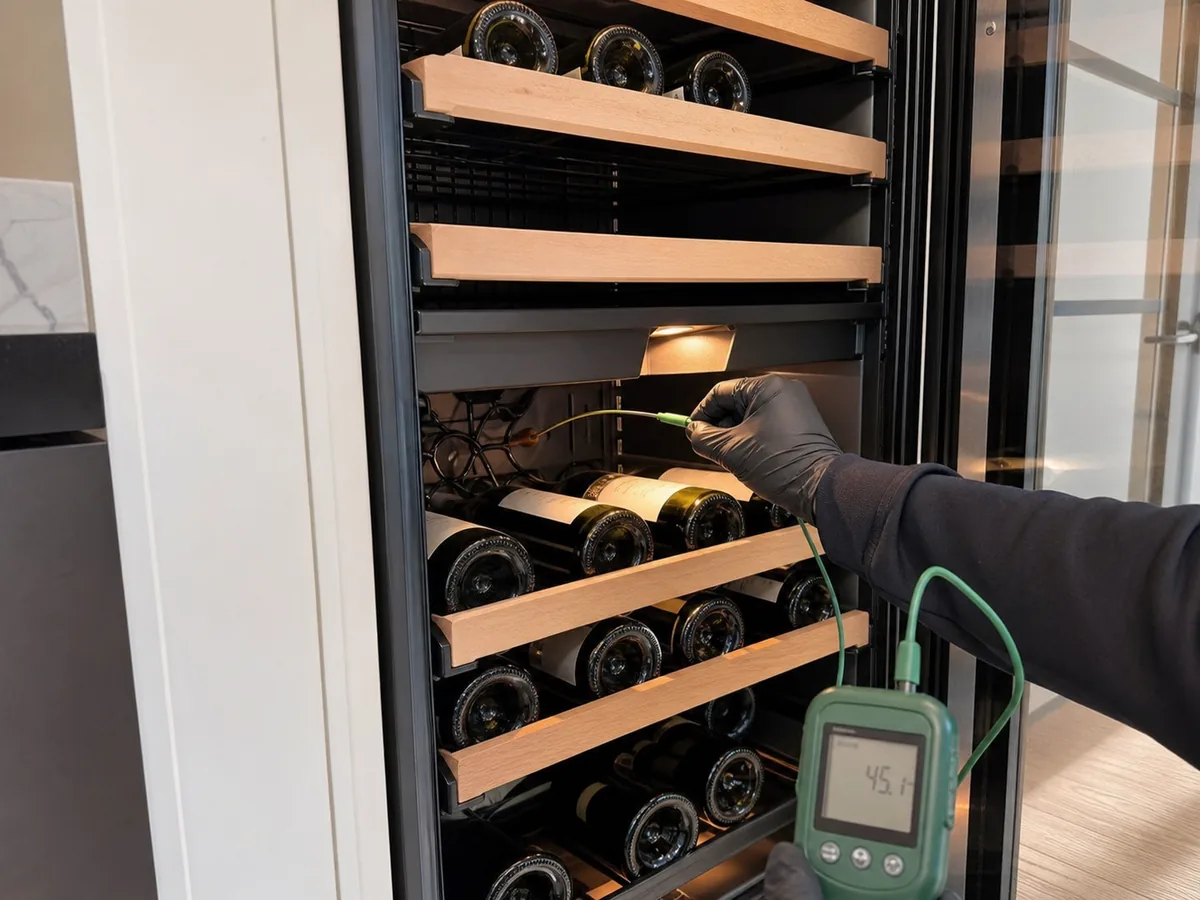
Most of these columns run two independent zones — a cooler band around 45-50°F for whites and sparkling, a warmer 55-60°F for reds — each with its own sensor and damper. When one zone holds but the other creeps, the fault is local to that zone: a drifting thermistor reading the air wrong, a damper that no longer modulates, or a small zone fan that has slowed. A technician reads both zones against a reference probe before touching anything, because a sensor reporting 55°F while the wine actually sits at 60°F looks like a cooling problem but is really a calibration one. On Hillsborough's cool, damp ridge mornings a marginal zone can read fine overnight and slip in the afternoon, which is why we log it over a run rather than trust a single glance.
Sealed system, condenser and the airflow the cabinetry hides
A wine column is refrigeration, so it shares the refrigerator's vulnerabilities — but estate kitchens add one of their own. These units are usually built into a tall cabinet run, panelled to match, and that tight enclosure plus the fine oak pollen and gravel-drive grit common on wooded Hillsborough lots loads the condenser quickly. A choked condenser makes the compressor run long and warm and is the single most common reason a healthy column starts losing its set point. Past that, the failures track refrigeration: an iced or sluggish evaporator fan, or — the expensive one — a refrigerant leak or tired compressor that we confirm on gauges before we ever discuss it.
Door seal, UV glass and the vibration that disturbs the bottle
Two faults are specific to wine. First, the door — the gasket and the UV-filtered glass seal keep warm room air and light out; a tired gasket lets the cabinet sweat and the warm zone climb, and on a glass door you can often see condensation tracking the failing edge. Second, vibration: Sub-Zero damps the compressor precisely because steady vibration unsettles sediment and ages a wine before its time. A column that has begun to buzz or rattle is not cosmetic — a failing fan bearing or a compressor mount that has let go is reaching the bottles, and on a serious cellar that is worth addressing promptly.