Cabinet/access risk, required evidence and service decision
| Cabinet/access risk | Required evidence | Service decision |
|---|---|---|
| Custom door panel or overlay | Wide installation view, hinge reveal check and panel weight symptoms | Plan protected access before approving gasket, hinge or pull-out work. |
| Tight lower grille or toe-kick | Grille, floor transition and model tag area | Allow extra time for airflow checks and avoid forcing trim. |
| Water line behind built-in unit | Water source location, slack estimate and leak location if present | Do not pull the unit until water and floor protection are planned. |
| Older 600/700 series installation | Serial tag, temperature pattern and cabinet clearance | Confirm part path before discussing replacement or sealed-system work. |
| Hillside or gated access window | Neighborhood, parking and staff/property-manager contact path | Route the visit with a realistic arrival window and access notes first. |
Repair path, planning range and proof required
| Repair path | Planning range | What must be proven |
|---|---|---|
| Diagnostic / service call | $195-$285 | Model, temperatures, airflow, door seal, alarm or display state. |
| Gasket, frost line or hinge correction | $520-$1,150 | Gasket profile, cabinet pressure, hinge alignment and frost location. |
| Ice maker or water path repair | $310-$985 | Water pressure, fill tube, valve response, filter status and module timing. |
| Evaporator or condenser fan motor | $365-$815 | Fan movement, bearing drag, coil load from coastal air and amp-draw evidence. |
| Control, sensor or thermistor path | $395-$1,450 | Electrical proof, error history, thermistor readings and serial range. |
| Compressor or sealed system | $1,850-$4,400 | Amp draw, condenser airflow, pressure evidence, leak suspicion and cabinet access conditions. |
Planning ranges are published for decision support. The final quote depends on model, serial range, part availability, cabinet access and diagnosis.
What not to approve before diagnosis
- A compressor or sealed-system replacement from a symptom description alone.
- A control board before the model/serial range and electrical evidence are checked.
- A cabinet pull-out before floor protection, water/electrical slack and panel clearance are documented.
- A full replacement recommendation without comparing repair range, part lead time and cabinet disruption.
Proof matrix
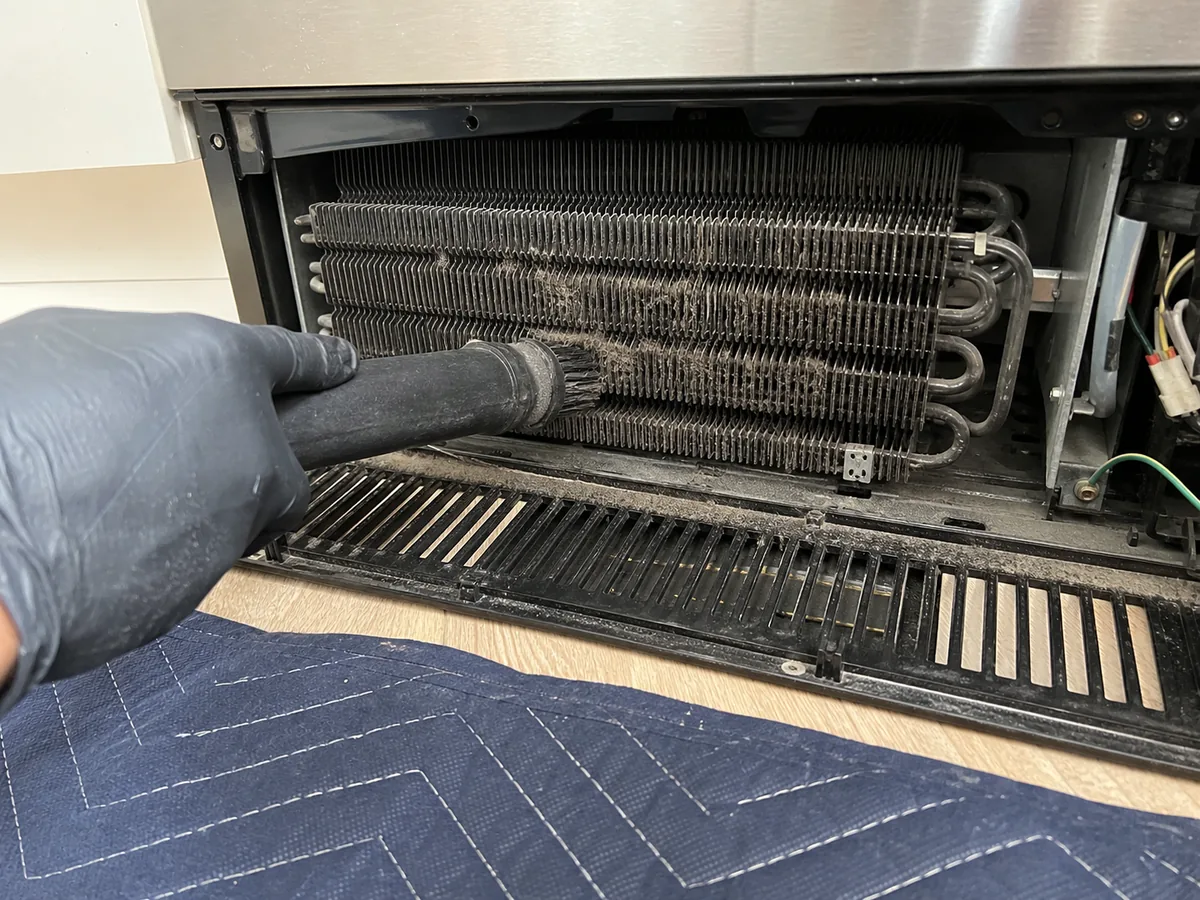
A compressor quote is one of the highest-risk approvals on a built-in Sub-Zero. The proof matrix should separate symptoms that mimic sealed-system failure from evidence that supports it. Dirty condenser airflow, condenser fan drag, gasket leaks, control behavior, sensor faults and cabinet heat can all make a unit run constantly or warm unevenly.
| Evidence | What it can prove | What it cannot prove alone |
|---|---|---|
| Temperature pattern | Whether one or both compartments are affected. | Exact failed component. |
| Condenser airflow | Whether heat rejection is blocked. | Refrigerant charge state. |
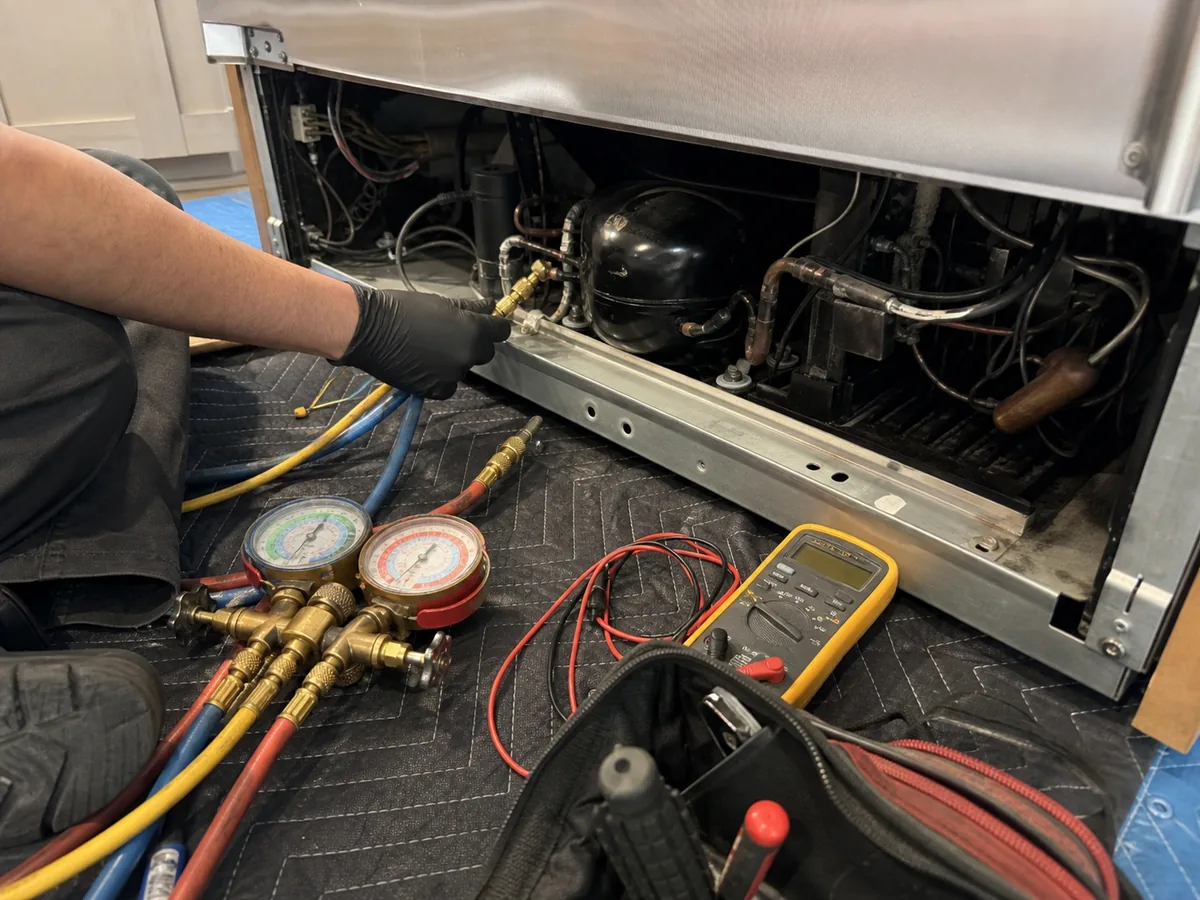
| Amp draw | Electrical behavior under load. | Leak location without more testing. |
| Pressure evidence | Sealed-system operating condition. | Cabinet access cost by itself. |
| Frost pattern | Airflow, door leak or evaporator behavior. | Compressor replacement need by itself. |
Do not approve from a guess
A constant-running compressor, warm fresh-food section or alarm can support a sealed-system investigation, but it should not approve a sealed-system repair by itself. The quote should explain what was measured, what was ruled out and how cabinet access affects the work.
If pressure testing or compressor access requires pull-out, the labor plan must include floor protection, panel clearance and water/electrical slack. In Hillsborough custom installations, those access conditions can be as important as the refrigeration diagnosis. And when failures start to repeat, the repair-vs-replace comparison deserves a seat at the table.
Approval also has a regulatory side. Opening the refrigerant circuit on a household refrigerator is credentialed work under Clean Air Act Section 608: the technician at the gauges holds EPA 608 certification and captures R-134a with dedicated recovery equipment instead of releasing it. How that standard reads from the household side — including the written record provided after sealed-system work — is described under certified refrigerant handling.
When replacement enters the conversation
Replacement becomes a stronger option when parts are unavailable, the cabinet opening is already being changed, the unit has repeated sealed-system failures or the repair range approaches the value of a reliable replacement path. It is weaker when the cabinet fit is valuable, the failure is isolated and the model has a reasonable part path. If the evidence does point at the compressor itself, the compressor replacement page describes how that work is staged in Hillsborough homes.
How a Sub-Zero sealed-system fault is proven before approval
The evidence order that separates a warm box from a true sealed-system failure on a Hillsborough built-in.
- Rule out airflow. Clean fog-loaded condenser coils and confirm the condenser fan moves air.
- Check the evaporator fan and door seal. A dragging fan or a leaking gasket can mimic a sealed-system fault.
- Measure amp draw. Record electrical behavior under load to support or rule out the compressor.
- Take a pressure reading. Confirm the sealed-system operating condition rather than guessing from temperature alone.
- Confirm the pattern. Only matching evidence justifies $1,850-$4,400 work, with a $285-$690 access add-on if pull-out is needed.