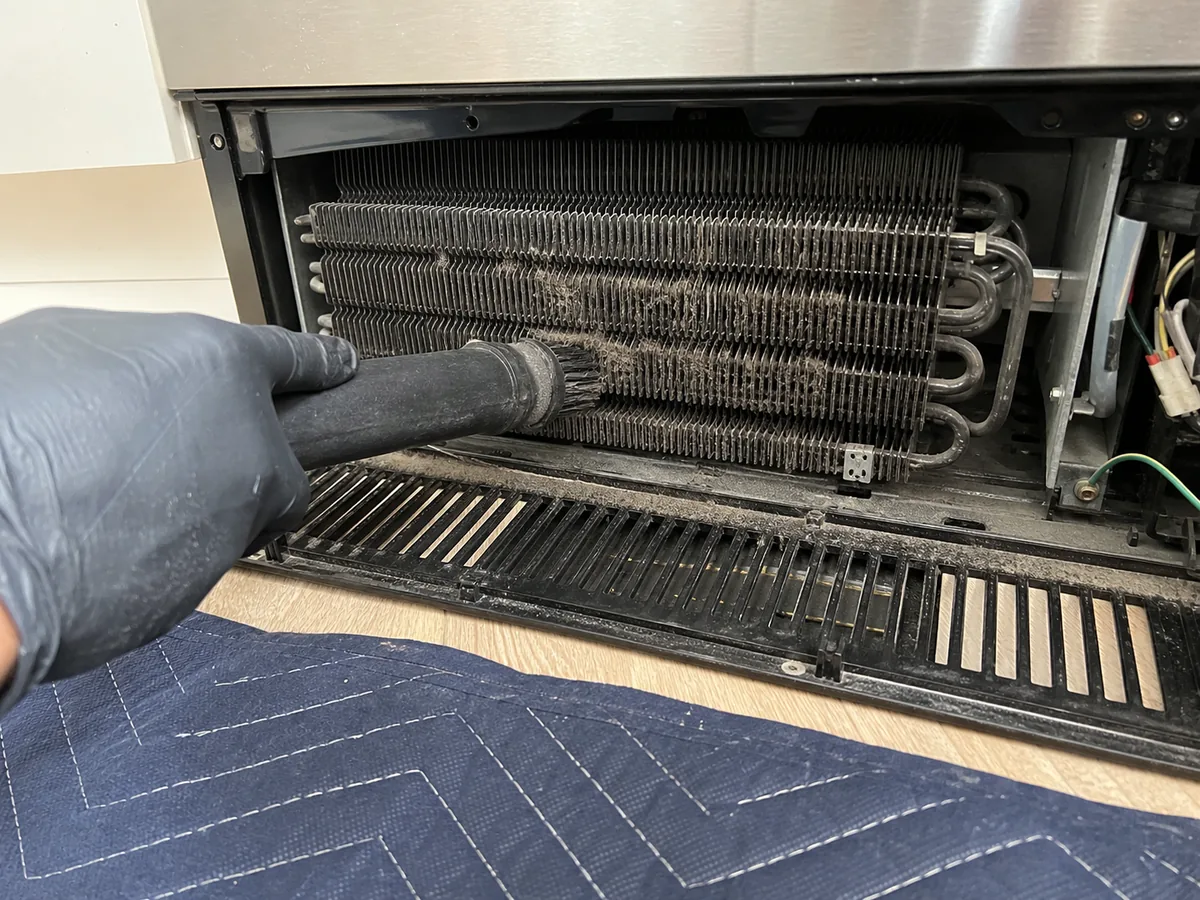
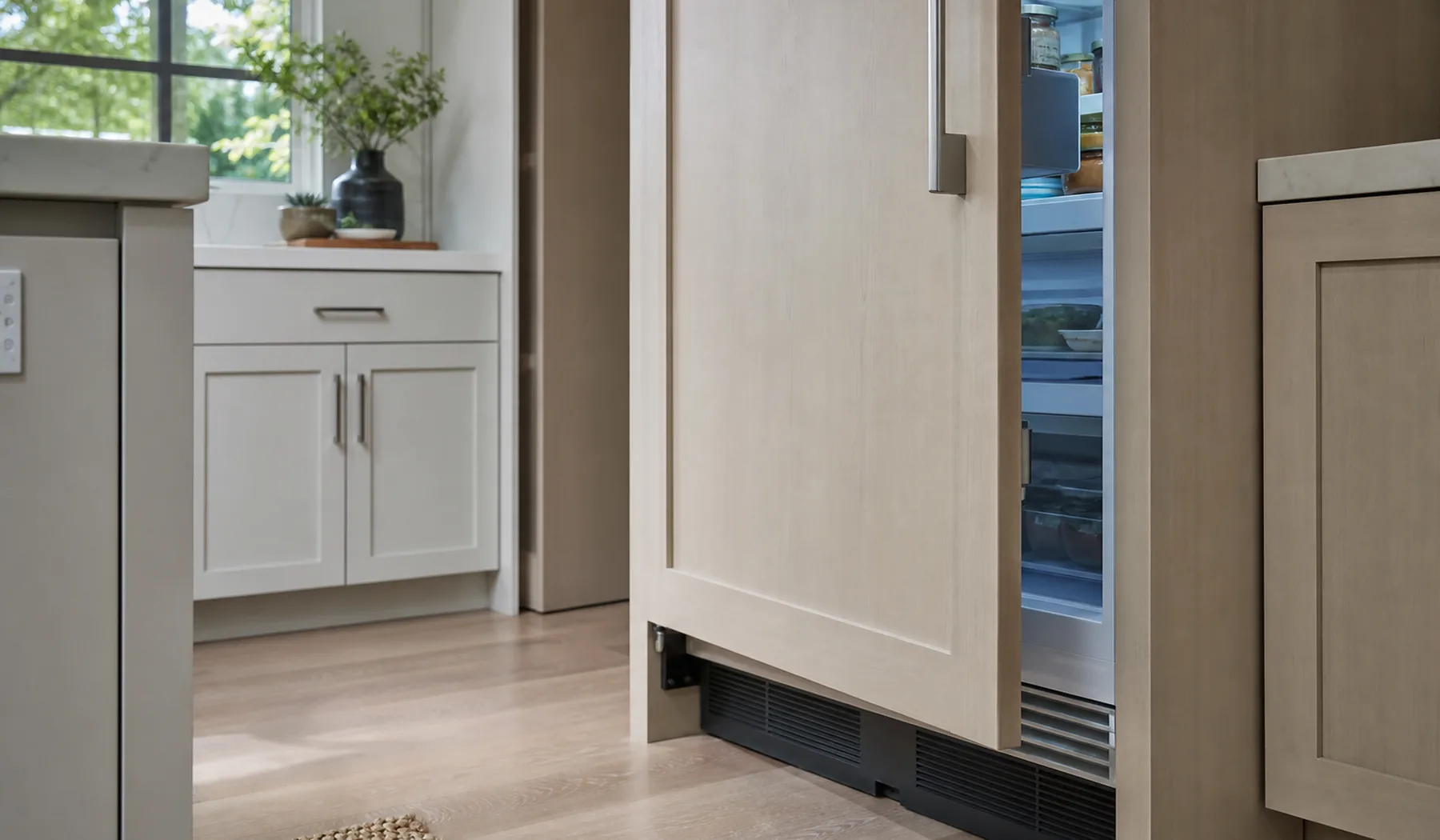
Cabinet/access risk, required evidence and service decision
| Cabinet/access risk | Required evidence | Service decision |
|---|---|---|
| Custom door panel or overlay | Wide installation view, hinge reveal check and panel weight symptoms | Plan protected access before approving gasket, hinge or pull-out work. |
| Tight lower grille or toe-kick | Grille, floor transition and model tag area | Allow extra time for airflow checks and avoid forcing trim. |
| Water line behind built-in unit | Water source location, slack estimate and leak location if present | Do not pull the unit until water and floor protection are planned. |
| Older 600/700 series installation | Serial tag, temperature pattern and cabinet clearance | Confirm part path before discussing replacement or sealed-system work. |
| Hillside or gated access window | Neighborhood, parking and staff/property-manager contact path | Route the visit with a realistic arrival window and access notes first. |
Repair path, planning range and proof required
| Repair path | Planning range | What must be proven |
|---|---|---|
| Diagnostic / service call | $195-$285 | Model, temperatures, airflow, door seal, alarm or display state. |
| Gasket, frost line or hinge correction | $520-$1,150 | Gasket profile, cabinet pressure, hinge alignment and frost location. |
| Ice maker or water path repair | $310-$985 | Water pressure, fill tube, valve response, filter status and module timing. |
| Evaporator or condenser fan motor | $365-$815 | Fan movement, bearing drag, coil load from coastal air and amp-draw evidence. |
| Control, sensor or thermistor path | $395-$1,450 | Electrical proof, error history, thermistor readings and serial range. |
| Compressor or sealed system | $1,850-$4,400 | Amp draw, condenser airflow, pressure evidence, leak suspicion and cabinet access conditions. |
Planning ranges are published for decision support. The final quote depends on model, serial range, part availability, cabinet access and diagnosis. Line-by-line figures, and what moves a quote inside each range, are kept on the Hillsborough repair-cost page.
What not to approve before diagnosis
- A compressor or sealed-system replacement from a symptom description alone.
- A control board before the model/serial range and electrical evidence are checked.
- A cabinet pull-out before floor protection, water/electrical slack and panel clearance are documented.
- A full replacement recommendation without comparing repair range, part lead time and cabinet disruption.
Why this repair path is different in Hillsborough
A built-in Sub-Zero can fail from ordinary refrigeration causes, but Hillsborough installations often add access risk. A warm refrigerator may be a fan, thermistor, control, door leak, condenser airflow issue or sealed-system problem. The same symptom can require a different plan when custom panels, stone floors, tight lower grilles or older 600/700 series cabinets are involved. A warm fresh-food section in particular has its own not-cooling diagnostic path worth reading before the first call.
The useful service path is to document the appliance and installation first. Model details, two temperatures, display or alarm status and a wide cabinet view allow the visit to be routed toward the right test. That prevents a generic part quote from becoming a cabinet problem.
How the diagnostic-first process works
The first conversation should identify risk: food temperature, water under the unit, wine drift, repeated alarms, frost, recent reset, power event, filter change or remodeling. The first visit should then connect that symptom to a measured test, not a replacement part guess.
If the likely repair is a gasket, ice maker, sensor, fan or control path, the model and serial range determine parts. The model number guide shows where each family carries its tag. If the likely repair is sealed-system work, pressure/electrical proof and cabinet access conditions become part of the quote.
- Capture model and serial before pricing parts.
- Record actual fresh-food, freezer and wine temperatures.
- Record frost, water, alarm codes and cabinet clearances.
- Approve the repair only after the first measured test.
Example diagnostic scenarios
These example scenarios show what evidence matters in a Hillsborough built-in installation and how each diagnosis is approached before parts.
Lower Hillsborough
Model family: BI-36 example scenario
Symptom: Fresh-food side at 48F while freezer held near 3F.
Tests: Model tag details, condenser airflow, evaporator fan response and door seal contact.
Outcome: Airflow and fan path reviewed before any sealed-system quote. Planning time: 1-2 hours.
Evidence: Evidence caption: thermometer reading beside a built-in lower grille.
Upper Hillsborough
Model family: 650 series example scenario
Symptom: Frost line returned near a panel-ready gasket after cleaning.
Tests: Temperature readings, gasket compression, hinge alignment and cabinet reveal pressure.
Outcome: Gasket and alignment path discussed; cabinet pull-out not approved from visual notes alone. Planning time: 1-3 hours.
Evidence: Evidence caption: close view of frost tracking along the gasket corner.
Carolands area
Model family: Wine column example scenario
Symptom: Upper wine zone drifted 5-7F across a day.
Tests: Set point, actual zone temperature, condenser airflow, door open history and recovery log.
Outcome: Temperature log requested before parts; inventory move considered if drift continued. Planning time: first diagnostic 45-90 minutes.
Evidence: Evidence caption: probe reading inside a wine column zone.
Country Club Manor
Model family: 700TCI example scenario
Symptom: Slow ice production and hollow cubes after filter change.
Tests: Water pressure, fill tube condition, valve response, filter status and module timing.
Outcome: Water path separated from ice maker module before quote. Planning time: 1-3 hours.
Evidence: Evidence caption: close view of fill tube and water-line access.
How to prepare a Hillsborough Sub-Zero repair visit
Five steps that keep a Hillsborough 94010 Sub-Zero visit accurate and usually limited to one trip.
- Read the model and serial. Find the tag inside the frame, behind the grille or on the column hinge side and record every letter and digit.
- Record two temperatures. Note actual fresh-food and freezer readings; a fresh-food side above 42 °F is the key symptom.
- Note the symptom and history. Capture frost, water, alarms, fan noise and any recent power event, cleaning or filter change.
- Photograph the installation. Take a wide shot showing custom panels, the lower grille and floor so cabinet access can be planned.
- Choose call or booking. Call for active cooling or water risk, or book online for a planned window. Expect a $195-$285 diagnostic.