
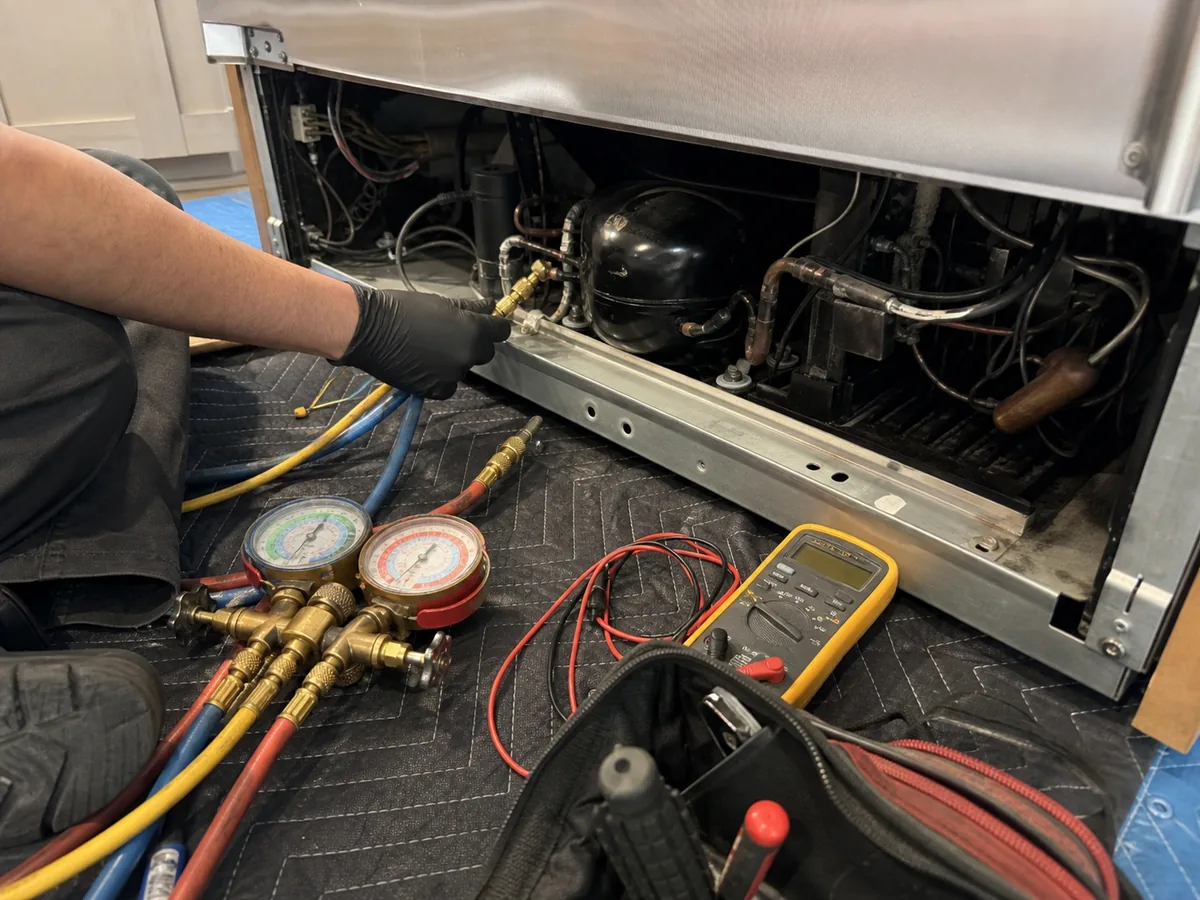
Most refrigerators share one cooling system between the freezer and the fresh-food compartment, so when one side goes warm the other usually follows. Sub-Zero is built differently. Each compartment has its own sealed refrigeration circuit, its own evaporator and, in the column designs, often its own compressor. That is the whole point of the brand — separate humidity and odor control for food storage. It is also why the failure you are seeing looks strange: the freezer can sit at 20°F while the refrigerator a few inches away reads a flawless 37°F.
So the first thing to understand is that a warm Sub-Zero freezer with a cold fridge is almost never a "the whole thing is dying" situation. It is a fault isolated to the freezer's half of the machine, and the job is to figure out which part of that half let go.
Why this slips by in a Hillsborough kitchen
In a lot of the homes we serve this symptom is caught late, and the reason is purely architectural. Hillsborough estates rarely have a single refrigerator. There is the main kitchen unit, a dual-refrigeration column or two in the butler's pantry, a freezer drawer set in an island, often a second full kitchen for catering, and a wine column nobody thinks of as refrigeration at all. A freezer column in the back pantry can run warm for two or three days before anyone opens it and finds the ice cream soft and the proteins thawed.
The tall built-in column freezers that are so common here also have their own quirk: the custom cabinetry-matched door panels are heavy, and over years that weight can pull a hinge slightly out of true so the gasket stops sealing at the top corner. Warm room air then bleeds in continuously, the freezer circuit runs nonstop trying to keep up, and the owner reads it as "not freezing" when the real culprit is a door that no longer closes square. It is worth ruling that out before assuming the worst.
Triage before you call
You can narrow the problem yourself in about an hour with a thermometer and a flashlight. Work in this order:
- Confirm which compartment is failing. Put a thermometer in the freezer and another in the fresh-food side, and read both after an hour. A freezer hovering above zero while the refrigerator holds 38°F tells you the freezer circuit alone is in trouble — a very different problem than the whole box drifting warm together.
- Check the door and the gasket seal. On a tall column freezer, an estate kitchen's heavy custom door panel can slowly drag the hinge out of alignment so the gasket no longer seats. Close the door on a dollar bill at several heights; if it slides out easily, warm room air is leaking in faster than the unit can pull it down.
- Listen for and feel the evaporator fan. Open the freezer and listen for the inner fan. No airflow from the vents, or a fan you can hear straining, means cold is being made at the evaporator but not circulated — a classic cause of a warm freezer with frost building only in one spot.
- Look for frost patterns and ice on the back wall. A solid sheet of frost on the rear inner panel points to a defrost-system fault; patchy or no frost with warm air points the other way, toward sealed-system or fan trouble. Photograph what you see for the technician.
- Note any column you don't open daily. Walk the butler's pantry, the second kitchen and the bar before you call. A warm column you rarely open may have been failing for days, and knowing how long it has been warm changes the food-safety and parts conversation.
The usual suspects, from cheapest to dearest
Once the symptom is pinned to the freezer side, the cause is almost always one of a short list. A poorly seating door gasket is the simplest and is worth checking first — see the dedicated door gasket and seal repair page if the seal looks tired. A failed evaporator fan motor stops cold air circulating even though the evaporator is still cold. A defrost-system fault — heater, thermostat or control — lets frost build into a block that smothers the evaporator, so the compartment slowly starves of airflow. A dirty condenser makes the whole unit work harder and can drag the freezer warm; if the panel is also showing a dirty-condenser prompt, start with the Vacuum Condenser (EC) alarm fix. At the expensive end sits a sealed-system or compressor fault on the freezer circuit, which is real but far less common than the others and should be confirmed, never assumed.
When to stop and call
If the freezer is still warm after you have confirmed the door seals and cleared any vent blockage, it needs diagnosis rather than more guessing. Defrost components, fan motors and especially sealed-system work require Sub-Zero-specific tools and refrigerant handling. Before you book, it helps to know what freezer repair costs by path, and if any error code is showing, the full error codes and alarms reference will tell you what the panel is reporting. For larger properties, the estate service protocol covers access, floor protection and coordinating around staff.