
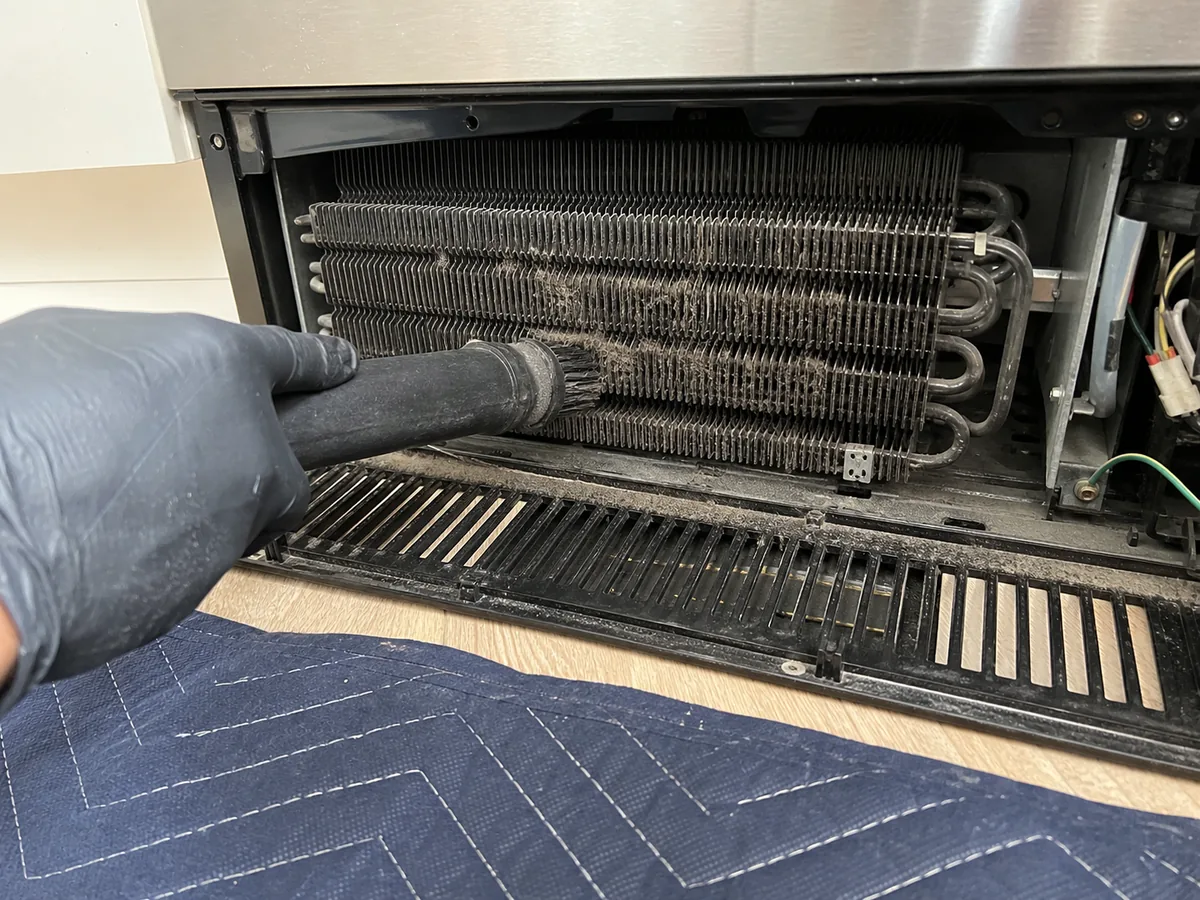
When a Sub-Zero throws its Vacuum Condenser prompt, the control board has decided the condenser is no longer rejecting heat the way the design expects. On the column refrigerators and the integrated 700-series boxes common in Hillsborough kitchens, that judgment is made from sensor temperatures and run-time, not from a person looking at the coil. So the message can feel sudden even though the fouling built up slowly over months.
The good news: nine times out of ten on a first occurrence, this is a cleaning task, not a repair. The board is asking you to restore airflow across the condenser fins. The reason it shows up so much more often here than in a typical inland home comes down to two very local conditions — the tree canopy and the marine air off Crystal Springs.
Why Hillsborough fouls condensers faster than most towns
Hillsborough's defining feature is its mature tree cover. The coast live oaks, valley oaks and the planted canopy over Upper Hillsborough and the Tobin Clark Estate area drop an enormous pollen and catkin load every spring, plus a fine leaf litter the rest of the year. That airborne debris is exactly the size that settles into a condenser's fin pack. Where an open-lot home in the East Bay might see a light grey dusting, an oak-shaded estate kitchen builds a felted mat across the fins in a single season.
Layered on top of that is humidity. The gap in the Coast Range at Crystal Springs Reservoir lets the marine layer push inland over western Hillsborough most evenings. That damp air does two things to a condenser: it makes the settled pollen sticky so it bonds to the aluminum instead of blowing off, and it raises the ambient heat-rejection load so the compressor already has to work harder before any blockage is counted. A coil that would stay serviceable for a year in a dry climate clogs in four to six months here. We see the tightest intervals on the lower, wetter properties near Skyline and the reservoir, and the heaviest pollen mats up in the canopy-dense streets above El Cerrito Avenue.
Clearing the alarm step by step
If you are comfortable removing a grille, the cleaning itself is straightforward. Work through it in order rather than skipping ahead — the power-down step matters.
- Note the message and the time. Write down exactly what the panel shows — many owners read the dirty-condenser prompt as a generic EC alarm — and the time it appeared. Keep the unit running; this is a maintenance prompt, not a shutdown, so the box stays cold while you work.
- Locate the condenser grille. On most Hillsborough built-ins the condenser sits behind the upper louvered grille on a column or behind the lower toe-kick grille on a 600-series under-counter or older 500-series unit. Pop the grille off its clips — no tools on the newer columns, a single thumb-turn on some 600s.
- Power down before you touch the coil. Switch the unit off at the panel or trip its dedicated breaker. The condenser fan can cycle on without warning, and on a panel-ready estate install the breaker is often in a back-hall or garage sub-panel, so confirm it is actually dead before reaching in.
- Vacuum and brush the fins. Use a soft brush and a vacuum with a crevice tool to lift the felted pollen-and-lint mat off the aluminum fins, brushing in the direction of the fins so you do not bend them. In oak-shaded homes the mat is often a quarter-inch thick by spring — far more than the light dusting a typical home leaves.
- Check the fan and the airflow path. Spin the condenser fan blade by hand; it should turn freely and quietly. Clear any drywall dust or cabinet debris from the air path above and below the grille, which on tight estate cabinetry is a common second choke point.
- Restart and clear the alarm. Refit the grille, restore power, and follow the panel prompt to acknowledge or reset the alarm. If the message returns within a day or two, the condenser was not the real cause — note that for the technician.
When it is not just a dirty coil
The reason this page is an explainer and not a one-line "clean it" instruction is that the same prompt appears for problems a vacuum will never fix. If the alarm returns within a day or two of a thorough cleaning, suspect the condenser fan motor — a bearing that is dragging cannot move enough air no matter how clean the fins are. A coil that looks spotless but still alarms can also point to a sealed-system or refrigerant condition, where the unit cannot shed heat because there is a charge or restriction problem rather than an airflow one. And on the older 500 and 700-series boxes still running in many Hillsborough estates, a tired control board occasionally raises the flag on its own. Those are diagnostic calls, not maintenance, and pushing on with a hot-running compressor is how a cleanable alarm turns into a compressor replacement.
Keeping the alarm from coming back
Because the local fouling rate is so high, the realistic maintenance cadence in Hillsborough is twice a year, not the once-a-year baseline you will read in the owner's manual — and quarterly if your kitchen sits under heavy canopy or near the reservoir. Folding a spring and a fall condenser cleaning into the seasonal maintenance calendar is the cheapest insurance against both the nuisance alarm and the compressor wear behind it. If the box is also running warm while the alarm shows, read the not-cooling diagnostic next, because a blocked condenser and a genuine cooling fault produce overlapping symptoms.